The Evolution of Graphic Design: From Print to Digital
Graphic design has never been a static discipline. It has always moved with the tools, technologies, and cultural forces of its time. What began with ink pressed onto paper has become a practice that spans screens, motion, interfaces, and everything in between. Understanding that arc isn't just historical curiosity — it's the foundation that separates designers who react to trends from those who understand why design works the way it does.
The Origins of Graphic Design in Print
Graphic design as a communicative practice began with the invention of movable type. Johannes Gutenberg's printing press in the mid-15th century didn't just change how books were made — it created the first systematic relationship between typography, layout, and mass communication.
Early printers were, by necessity, the first graphic designers. They made decisions about typeface selection, line spacing, margin proportions, and page hierarchy long before those decisions had formal names. The constraints of offset printing and later lithography forced a discipline that still echoes through contemporary layout grids.
By the late 19th and early 20th centuries, commercial print design had matured into a recognizable profession. Advertising posters, magazine layouts, and book covers demanded visual thinking that went beyond mere text arrangement. Designers like Alphonse Mucha and later Paul Rand brought artistic intentionality to commercial work, establishing that design could be both functional and expressive.
The tools were physical: metal type, ruling pens, paste-up boards, and darkrooms. Every layout decision had a material consequence. That constraint, frustrating as it was, produced a generation of designers with an instinctive understanding of proportion and visual weight.
The Bauhaus and the Birth of Modern Design Principles
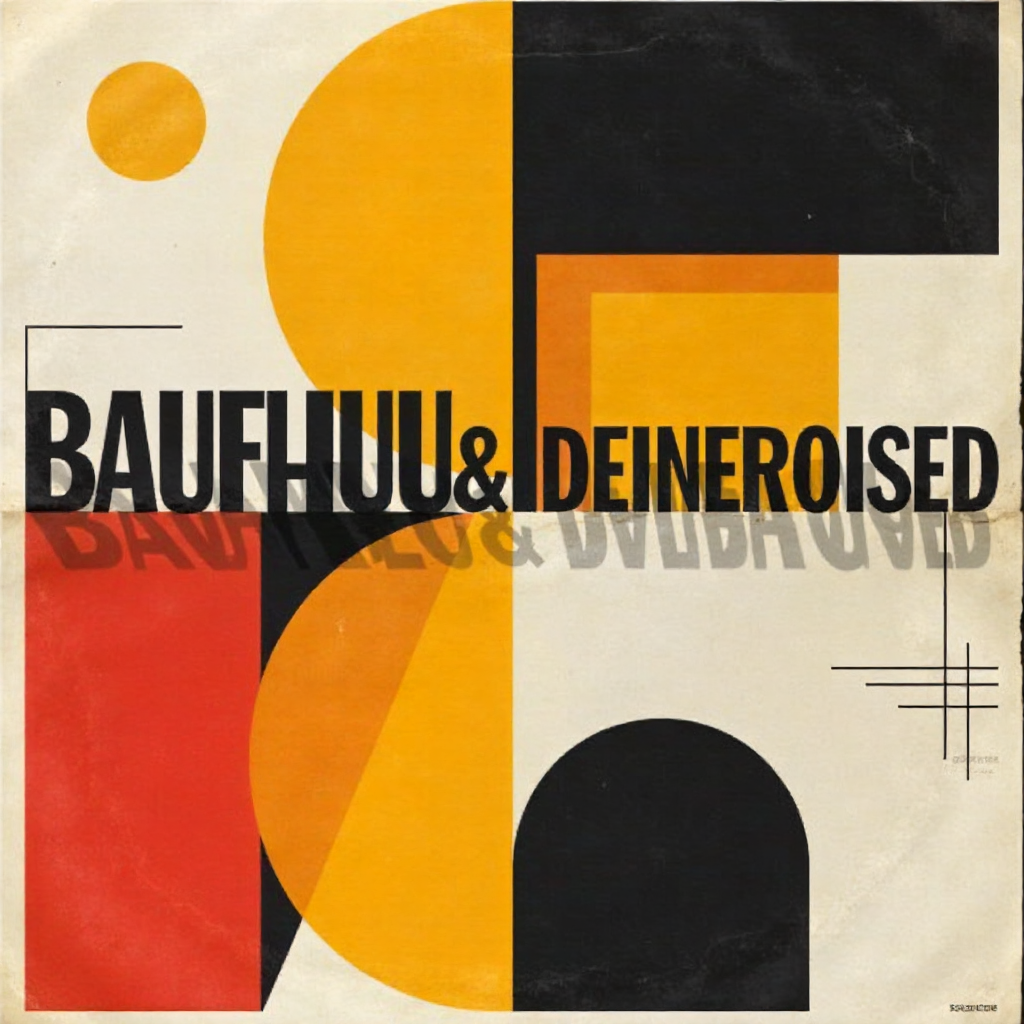
The Bauhaus school, founded in Weimar, Germany in 1919, formalized the visual language that still underpins graphic design today. Its core proposition was radical for the time: that art, craft, and industry should operate from the same principles.
What the Bauhaus gave design wasn't just an aesthetic — it was a systematic framework. Grid systems, typographic hierarchy, the relationship between form and function, the use of white space as an active element rather than empty absence. These weren't stylistic preferences; they were argued as universal principles of visual communication.
Herbert Bayer's experiments with universal typography, László Moholy-Nagy's work on visual perception, and the school's broader emphasis on geometric clarity created a vocabulary that designers still reach for. When you look at a well-structured brand identity or a clean editorial layout today, you're often looking at ideas that trace directly back to Dessau in the 1920s.
The Bauhaus was closed by the Nazis in 1933, but its faculty scattered across Europe and the United States, seeding design schools and advertising agencies with its principles. That diaspora is one reason modern design thinking feels so globally coherent — it has a shared intellectual ancestry.
The Desktop Publishing Revolution
The 1980s didn't just change how designers worked — they changed who could work as a designer. The arrival of the Apple Macintosh in 1984, followed by Aldus PageMaker and the LaserWriter printer, triggered what became known as the desktop publishing revolution.
Before DTP, producing a professionally typeset document required a typesetting house, a paste-up artist, and a print shop. After it, a single person with a Mac could do all of that on a desk. The democratization was real and significant. Small publications, independent designers, and non-profits suddenly had access to production capabilities that previously required substantial infrastructure.
The trade-off was predictable: a flood of poorly designed output. When the barriers to production drop, the barriers to bad design drop with them. The late 1980s produced a wave of documents with seventeen fonts, drop shadows on everything, and clip art used without restraint. The tools outpaced the design education available to use them well.
But the serious designers adapted quickly. By the early 1990s, the traditional print workflow had been largely replaced. Film separations, color proofing, and prepress production moved onto the desktop. The physical skills of paste-up became obsolete; the conceptual skills of layout, hierarchy, and typographic judgment became more important than ever because the tools no longer enforced discipline automatically.
The Rise of Digital Tools and Creative Software
Adobe's software ecosystem transformed what graphic design could do. Photoshop (1990), Illustrator (1987), and eventually InDesign (1999) didn't just replicate print workflows digitally — they expanded them in directions that weren't previously possible.
Vector graphics in Illustrator meant that a logo could scale from a business card to a billboard without any loss of quality. That single capability restructured how branding and visual identity work was approached. Photoshop gave designers control over photographic imagery that previously required a darkroom and specialized skills. InDesign eventually replaced both QuarkXPress and PageMaker as the standard for multi-page layout, with a level of typographic control that rivaled dedicated typesetting systems.
The Adobe Creative Suite became the de facto professional standard across print, advertising, and publishing. Learning these tools wasn't optional for working designers — it was the entry requirement. This created a new kind of design education challenge: software proficiency and design thinking had to be taught simultaneously, and they're not the same skill.
One consequence worth noting: the ease of digital experimentation changed the design process itself. Where a print designer might carefully plan a layout before committing it to paste-up, digital designers could iterate rapidly, generating dozens of variations. That's genuinely useful — but it can also substitute activity for thinking. The best digital designers learned to bring the deliberateness of print thinking into a faster medium.
From Static Screens to Interactive Design — The Web Era
Web design introduced a constraint that print had never faced: the reader could interact with the design, and the design had to respond. That shift from static to interactive fundamentally changed what "design" meant in practice.
Early web design in the mid-1990s was largely handled by developers, not designers. The visual results showed it. As browsers became more capable and the web became commercially significant, designers moved in — and immediately ran into the problem that print principles didn't translate cleanly. Fixed-width layouts, pixel-perfect control, CMYK color — none of it applied. The screen was a different medium with different rules.
Responsive layouts became the central design challenge of the 2010s. A layout that worked on a desktop monitor had to work on a tablet and a phone, often with the same underlying content. This pushed designers toward thinking in systems rather than fixed compositions — a significant conceptual shift from print, where the physical dimensions of a page are known in advance.
From this emerged UI/UX design as a distinct discipline. User interface design focused on the visual and interactive elements of digital products; user experience design addressed the broader logic of how people moved through them. The two overlapped significantly, and the boundary between them remains contested. But together they represented a new professional category that hadn't existed in the print era — one that required design thinking, psychology, and technical literacy in roughly equal measure.
Motion graphics added another layer. As video and animation became native to digital platforms, designers who had worked in static media found themselves working with time as a design element. Timing, easing, transition — these had no print equivalent. They came from film and broadcast, and their integration into mainstream digital design is still ongoing.
Where Print and Digital Intersect Today
Modern graphic design doesn't live in one medium — it moves across all of them. A brand identity project today typically produces a logo system that works on a printed business card, an app icon, a social media profile, an animated intro sequence, and environmental signage. The designer has to think across all of those contexts simultaneously.
Print hasn't disappeared. Packaging design, editorial publishing, large-format printing, and luxury branding all remain significant markets. What has changed is that print production knowledge is now a specialization rather than a baseline assumption. A digital-native designer can go years without needing to understand ink trapping or bleed margins — until a client asks for a packaging project, and then that gap becomes visible.
The core principles that the Bauhaus articulated — hierarchy, balance, proportion, typographic clarity — apply regardless of medium. A well-structured layout works whether it's on coated paper or a phone screen. Typography that communicates clearly in print communicates clearly digitally. The medium changes the constraints; it doesn't change the underlying logic of visual communication.
Variable fonts are a good example of this continuity. Developed as a digital technology, they allow a single font file to contain a full range of weights and widths that can be adjusted dynamically. But the typographic thinking behind them — how weight affects hierarchy, how width affects rhythm — is identical to what a Bauhaus typographer would have applied to metal type. The tools are new; the principles are not.
What This Evolution Means for Designers and Portfolios
For working designers, understanding this history isn't nostalgia — it's competitive context. The designers who understand why design principles work, not just how to apply them in current software, are the ones who adapt when the tools change again. And they will change again.
A portfolio that demonstrates range across print and digital contexts signals something specific: that the designer thinks about communication problems, not just software outputs. Showing a brand identity alongside the packaging it lives on, or a web design alongside the editorial system it came from, tells a more complete story than a gallery of isolated screen mockups.
Practically, this means a few things for designers building or refining their practice:
- Typography remains the most transferable skill. Whether you're setting a book, designing an app, or creating a motion graphic, understanding typographic hierarchy is the foundation. It's worth studying beyond what software tutorials cover.
- Print production knowledge is a differentiator, not a requirement. Most digital designers don't need it daily, but having it opens doors to packaging, publishing, and brand identity projects that purely digital designers can't serve well.
- Systems thinking matters more than individual execution. Modern design projects — especially branding and UI work — require designing rules and components, not just individual pieces. That's a different skill from making a single beautiful poster.
- Motion and interaction are no longer optional specializations. Even designers who work primarily in print or branding are expected to have a working understanding of how their assets will animate or behave in digital contexts.
The through-line from Gutenberg's press to a contemporary design system is longer than it might seem, but it's unbroken. Every shift in tools and medium has added new capabilities without invalidating what came before. Designers who understand that continuity work with more confidence and more depth than those who treat each new platform as a fresh start.
Frequently Asked Questions
What is the difference between print design and digital design?
Print design produces output for physical media — books, posters, packaging — with fixed dimensions and color managed through CMYK ink systems. Digital design produces output for screens, which are variable in size and use RGB color. The core principles of layout and typography apply to both, but the production requirements, file formats, and technical constraints differ significantly.
When did graphic design become a recognized profession?
The term "graphic design" was coined by William Addison Dwiggins in 1922, though the practice existed well before that label. By the mid-20th century, with the growth of advertising, publishing, and corporate identity work, graphic design was established as a distinct professional discipline with dedicated education programs and industry organizations. You can read more about the broader history at the AIGA's design history resources.
Do graphic designers still need to understand print production?
Not universally, but it depends on the work. Designers focused on UI/UX or social media can work effectively without deep print knowledge. Those working in branding, packaging, editorial, or advertising will encounter print production regularly. Understanding how designs translate to physical output — including color accuracy, bleed, and material constraints — remains a genuine professional advantage in those contexts.
How has the role of typography changed from print to digital?
Typography has expanded rather than changed fundamentally. The core principles — hierarchy, readability, proportion — are the same. What's different is the range of contexts: type now needs to work at small sizes on phone screens, in motion, in variable font implementations that respond to user settings, and across wildly different display environments. Digital typography also introduced new challenges around rendering, anti-aliasing, and system font fallbacks that have no print equivalent.
What skills do modern graphic designers need compared to traditional designers?
Traditional print designers needed strong craft skills in typography, layout, and color, plus technical knowledge of print production. Modern designers need those same foundations plus proficiency in digital tools (Adobe Creative Suite at minimum), an understanding of screen-based design constraints, familiarity with responsive layout logic, and increasingly, some working knowledge of motion and interaction. Systems thinking — designing components and rules rather than individual artifacts — has become more central to professional practice than it was in the print era.