Freelance vs. In-House Design: Which Career Path Is Right for You?
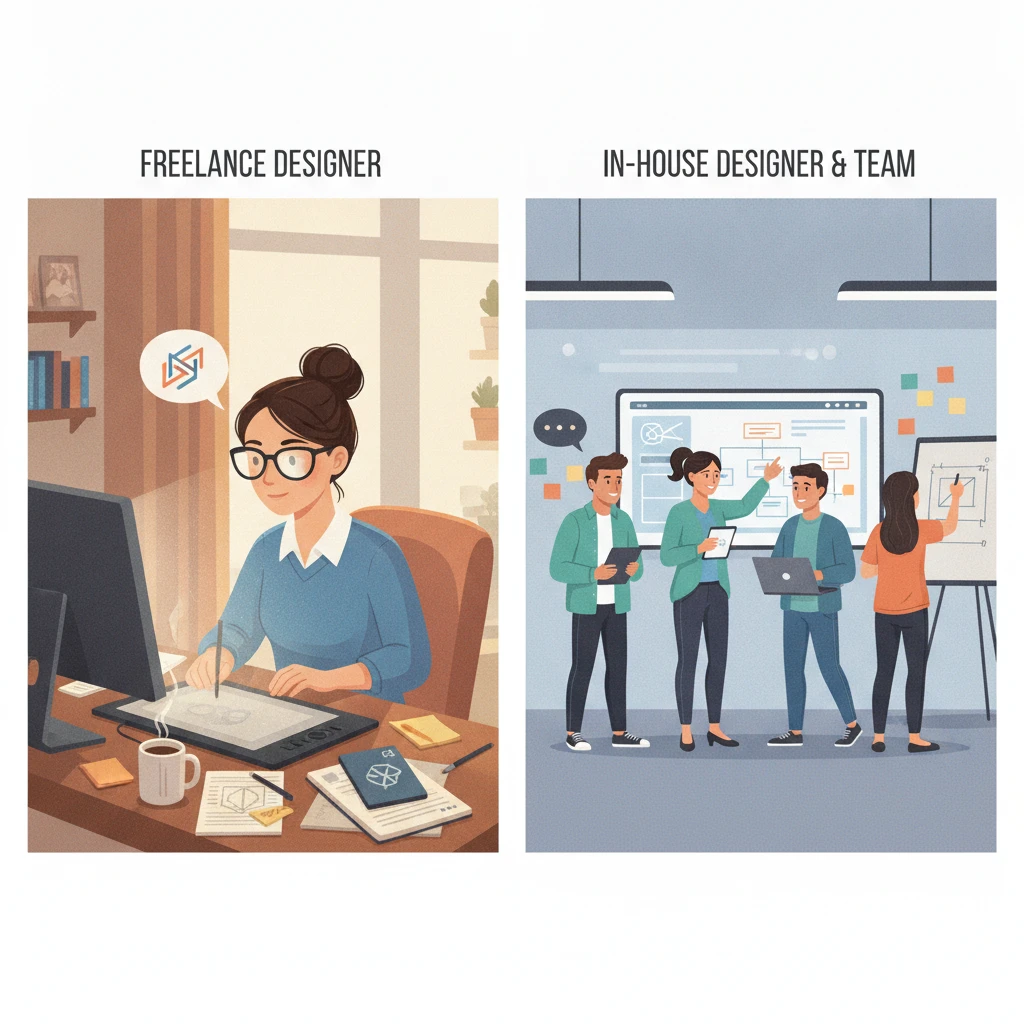
Choosing between freelance and in-house design affects more than where you work. It shapes how you find projects, build client relationships, collaborate, manage income, and develop your skills. Neither path is automatically better; the right fit depends on the kind of work and working life you want.
Use the comparisons below to weigh everyday realities alongside long-term goals. Your design portfolio can support either direction, but the evidence you highlight should match the people making the decision: clients or hiring teams.
How freelance and in-house design differ
A freelance designer works independently for clients, while an in-house designer is employed by one organization and designs for its products, services, or communications. The main difference is who brings in the work and how closely the designer is connected to one business.
Freelancers often find work through referrals, existing client relationships, agencies, or their own outreach. They agree on a project scope, schedule, and payment terms, then deliver work to one or more clients. That independence also brings responsibilities such as writing proposals, scheduling projects, following up on invoices, and keeping future work in view.
In-house designers usually receive priorities from a manager or team and work within an organization’s processes. They may focus on a single brand or product over time, coordinating with marketing, product, engineering, research, or other partners in a cross-functional team. Instead of pitching for each assignment, they help meet ongoing business needs.
The labels cover a range of arrangements. A freelancer might work with one company for several months, while an in-house designer may contribute to different products or teams. Compare the actual responsibilities, expectations, and working relationships in an opportunity rather than relying on the job title alone.
Autonomy, variety, and daily work
Freelance design usually offers more control over clients, schedule, and project mix; in-house design generally offers closer collaboration and a more consistent working rhythm. The amount of autonomy in either role depends on the client, manager, team, and organization.
Freelancers can often choose which projects to pursue, shape their services, and decide where and when to work. That creative autonomy has limits: clients set goals, budgets, deadlines, and approval processes. A designer may choose the route to a result without controlling what the result needs to achieve.
In-house work can mean fewer changes of client, but more time spent learning an audience, product, and internal systems. Designers may see a project through research, launch, and later improvements. Feedback and decisions involve colleagues, which can bring useful context but may also require negotiation and patience.
Consider how you feel about the less visible parts of each day. Freelancers spend time on project management, business development, and client communication as well as design. In-house designers may spend more time in planning meetings, reviews, and coordination. Ask whether you want to manage more of your own pipeline or share responsibility for priorities and decisions.
Income, stability, and benefits
Freelance income depends on paid projects and how consistently a designer can find and deliver them; an in-house role usually provides an agreed salary and may include employee benefits. Neither arrangement guarantees financial security, and details vary by contract, employer, location, and personal circumstances.
Freelancers can set rates and pursue different kinds of work, but revenue may change from month to month. Time spent marketing, handling administration, or waiting for payment is not always billable. To assess whether a project rate is workable, account for the full effort: discovery, revisions, meetings, delivery, and the business tasks around the work.
An employee’s regular pay can make budgeting more straightforward. Depending on the employer and location, benefits may include paid leave, health coverage, retirement contributions, or equipment. In return, the designer may have less control over workload and schedule, and job security still depends on the organization and employment terms.
Before choosing, compare the whole financial picture rather than salary with a freelance day rate. Consider taxes, unpaid leave, insurance, retirement saving, business expenses, and gaps between projects. For an in-house offer, review the written compensation and benefits details; for freelance work, examine payment milestones, cancellation terms, and scope changes.
Creative growth and career development
Freelancers can develop through varied projects and direct client feedback, while in-house designers may grow through sustained product knowledge, mentorship, and collaboration. Career development depends on the opportunities and feedback available, not simply on employment status.
Working across clients can expose a freelancer to different industries, audiences, and constraints. That range can build adaptability and help clarify a specialty. The trade-off is that short engagements may offer little access to mentorship or to what happens after a design is delivered. Freelancers can address this by seeking peer critique, training, or longer-term client partnerships.
In-house designers may learn from regular design reviews and colleagues with different expertise. Staying close to a product can also make it easier to understand how decisions perform over time. Yet a narrow remit or limited team can restrict exposure to new challenges. Ask how work is assigned, how feedback happens, and whether the role offers room to take on greater responsibility.
For either path, look for evidence of learning rather than assuming that variety or a company title signals growth. Have you gained stronger judgment, handled more complex problems, or learned to explain design decisions clearly? Those are useful signs of career development wherever you work.
How your portfolio can support either path
A strong design portfolio makes relevant work easy to understand and shows how you reached the outcome. For freelance opportunities, emphasize fit and dependable delivery; for in-house hiring, show how you work with teams and respond to ongoing product or business needs.
Clients often want to know whether you can solve a problem like theirs, communicate clearly, and deliver within a defined scope. Select projects that match the kind of work you want to win. Explain your role, the client’s goal, key decisions, and what you delivered. If you worked with a team, state your contribution accurately and respect confidentiality agreements.
Hiring teams may look for your design judgment as well as your ability to work through constraints and feedback. Include examples that show process: what you learned, which options you considered, how you collaborated, and how the work changed after review. When you can share results, distinguish observed outcomes from goals or estimates.
- For freelance clients: make your services, relevant experience, process, and next steps clear.
- For in-house roles: show collaboration, problem-solving, adaptation to feedback, and understanding of the product or audience.
- For both: curate a few focused case studies rather than presenting every project without context.
Your portfolio cannot remove every hiring or client concern, but it can make the conversation more specific. Be prepared to discuss trade-offs, team contributions, and what you would improve with more time.
Which path fits your priorities?
The better career path is the one whose regular demands fit your priorities, responsibilities, and tolerance for uncertainty. Compare the work you want to do with the work required to sustain each arrangement.
Try this three-part fit check. First, consider your preferred work rhythm: do you want to switch among clients, or build context inside one organization? Second, assess your appetite for business administration and variable demand. Third, identify the support you need, such as mentorship, benefits, schedule flexibility, or control over project selection.
- Freelance may suit you if you value choosing clients, can manage outreach and project administration, and have a plan for uneven workloads.
- In-house may suit you if you prefer shared goals, regular collaboration, and deeper involvement in one organization’s work.
- Either path may fit if your priorities are specific: for example, autonomy may matter more than variety, or team learning may matter more than a predictable routine.
Before changing direction, ask yourself: What do I want my typical week to look like? How much income variation can I manage? Where will I get feedback? What responsibilities outside work affect my choice? What would make me reconsider after six months? Your answers can help turn a vague preference into a practical decision.
Trying a path before committing
You can test freelance or in-house work through small, clearly bounded steps before making a major career change. A short trial helps reveal the daily demands that a job title or portfolio cannot show.
If you are considering freelance work, take on a limited project only after checking your employment agreement and any relevant conflict-of-interest rules. Define the deliverables, revision limits, timeline, payment schedule, and communication expectations in writing. Track time spent on client work and administration so you can judge whether the arrangement suits you.
If you are considering an in-house role, talk with designers who work in organizations similar to the ones you are considering. Ask about review cycles, decision-making, team relationships, and how priorities change. You can also assess a job posting against your portfolio: identify which examples demonstrate the responsibilities it describes and where you would need to build experience.
A hybrid arrangement may be possible, but confirm that outside work is permitted and manageable. Keep client work separate from employer resources, avoid conflicts of interest, and set realistic limits on availability. A small experiment, followed by an honest review of workload, finances, and satisfaction, gives you better evidence than choosing based on assumptions.
Frequently asked questions
Can a designer combine freelance and in-house work?
Sometimes. A designer may freelance outside an in-house role if the employer permits it and the work does not create a conflict of interest. Check the contract and policies, protect confidential information, and make sure the combined workload is sustainable.
What should a freelance design portfolio include?
Include focused case studies relevant to the clients you want, with the problem, your role, process, deliverables, and any verified results. Make your services and working approach easy to understand, and do not share client work without permission.
How does an in-house design portfolio differ?
An in-house portfolio should make collaboration and decision-making visible. Show how you understood the audience or product, handled constraints and feedback, and contributed within a team. Clearly separate your work from others’ contributions.
Which path offers more creative freedom?
Freelancing may provide more control over client selection and project mix, while in-house work may give a designer more context to shape a product over time. Actual creative freedom depends on the brief, decision-makers, team culture, and business constraints in each role.